Becoming an End-of-Life Companion, Part 4: My Relationship with Death
We recently had our first full-immersion weekend, exploring our own relationship with death, loss, and anxiety. It was intense, but extremely valuable. Here are some of the key insights I took away from it.
❧ Do your own work first
If you want to be of real help to a dying person, you first need to get your own relationship with death in order. What a dying person needs is someone who can truly be present for them, not someone who can't separate their own struggles from the other person's.
❧ What is your relationship with fear?
Fear will be present when you do this kind of work. That's why we did an exercise in which we each picked one of our core fears and started a conversation with it. It helped us understand that we can't get rid of fear, it's part of life, but we can change our relationship with it. This exercise was a game changer for me: I found my voice toward something so terrifying that I'm usually left speechless. It's since become one of the exercises I offer to others interested in changing their own relationship with fear.
❧ Be mindful of the mood and energy you bring into the room
A dying person is very sensitive to the moods and energies around them. If you're not up for a visit, or you lack the inner peace it requires, cancel it rather than pushing through, because the person will see straight through you. At the same time, you should feel free to share when you're overwhelmed or exhausted. What matters most is transparency: you can't fake it with death.
❧ You need a source of strength
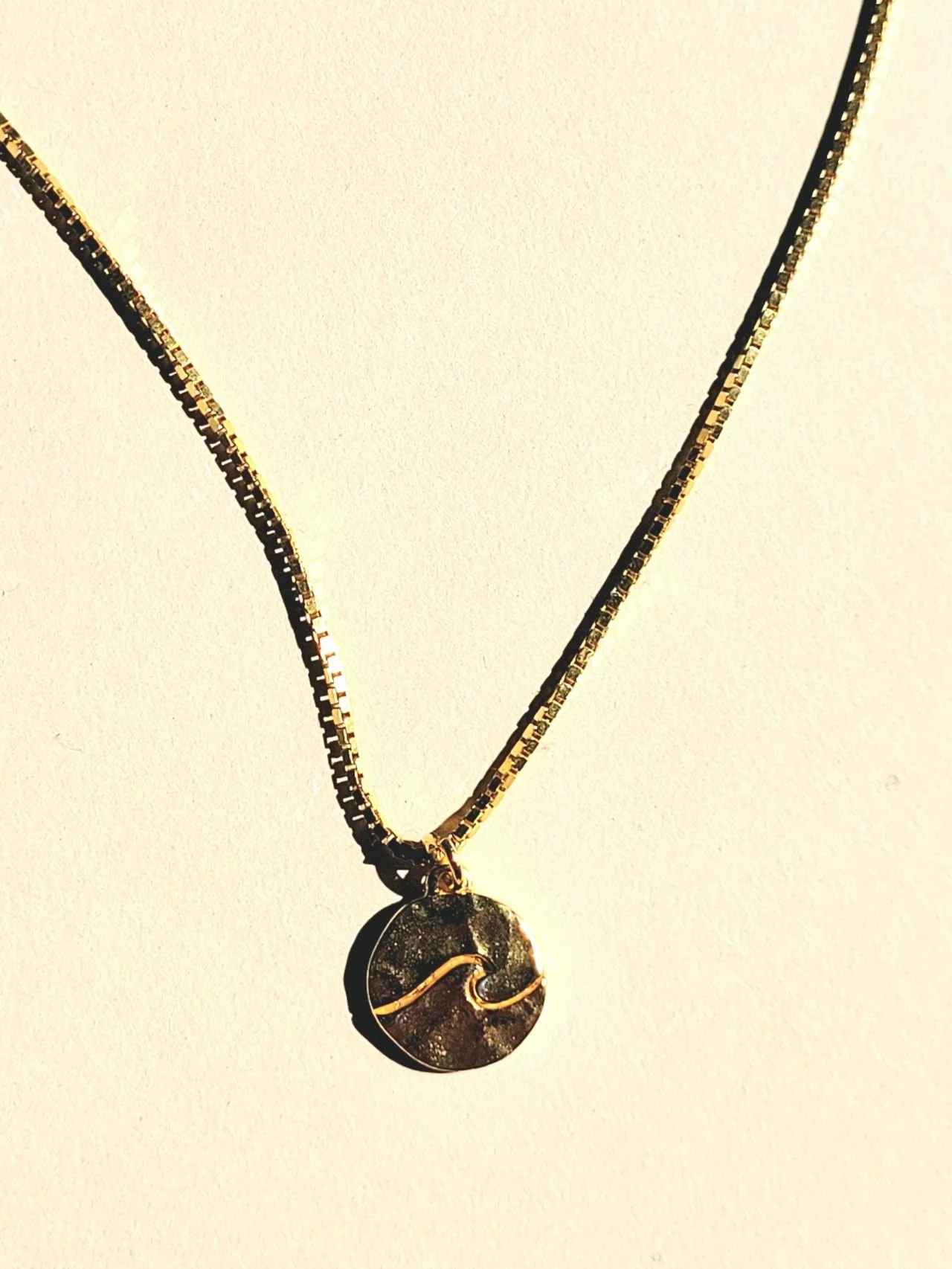
Dealing with death and fear is extremely challenging, which is why you need a personal source of strength you can draw on whenever you need it. It can be religious, spiritual, connected to nature, or simply a symbol; what matters is that it's something you can genuinely draw strength from. Our trainer repeatedly emphasized how important it is to keep a close relationship with that source, and to build a regular practice around it.
Below is a picture of my own source of strength: a necklace with the symbol of a wave. I got it when I started this training, sensing I would need it. The wave is often used as a metaphor for life, death, and non-duality. A wave rises from the ocean, peaks, and then breaks, so it's tempting to think of it as something born and later dying. But in the end, a wave is simply a different shape the water takes for a while. The water was there long before the wave rose, and it remains there long after the wave is gone. That's exactly why I chose the wave as my symbol: it reminds me that we are not the wave, we are the water.