How this all started (spoiler, there's no sob story origin)
'So what got you into all this death stuff?'
I've been asked that question more times than I can count. In an interview for an undertaker's magazine, on conference panels, in every workshop I run, and once, by the one elderly aunt who dared, peering at me over the rim of her tea cup like she was bracing for something dreadful.
You'd think by now I'd have a slick answer ready. The truth is, I'm still working it out.
The short version goes one of two ways. Either I studied psychology and wrote my dissertation on suicide and self-harm, or I got fed up with funerals that had zero personality, the kind where anyone could be ‘in the box’ and nobody would notice. Both of those are true. (Funeral design has come on a lot in the last decade, so that second complaint dates me somewhat). But if I trace the brightest spark back to its source, it started in Berlin in 2012, at an innovation agency where a side project took on a life of its own.
A handful of us there, mostly designers and anthropologists, restless with how things were, and under the leadership of Dörte Töllner decided it was time to 'innovate death'. I still remember how odd that phrase sounded the first time someone said it out loud in a meeting. We called the project Redesigning Death.
Working with strategic designer Virginie Gailing and Lea Gscheidel, a mortician-in-training at Charon Bestattungen, we set out to actually understand the basis of the taboo and use human-centric design principles to get to the bottom of it. We made wonderful alliances with anthropologist Inga Treitler and a design ethnography team from Dundee University led by Catriona Macauley. Together we conducted over a hundred interviews across Berlin and Dundee: undertakers, ministry officials, palliative care staff, hospice workers, along with anyone else who'd sit with us. What we found surprised us. People wanted to talk about it. They just needed the right space and a bit of gentle permission. I remember at one of our first workshops during Berlin Design Week, complete strangers were swapping intimate stories and fears with each other, which we found so surprising at the time. Over the years I’ve come to almost expect this.
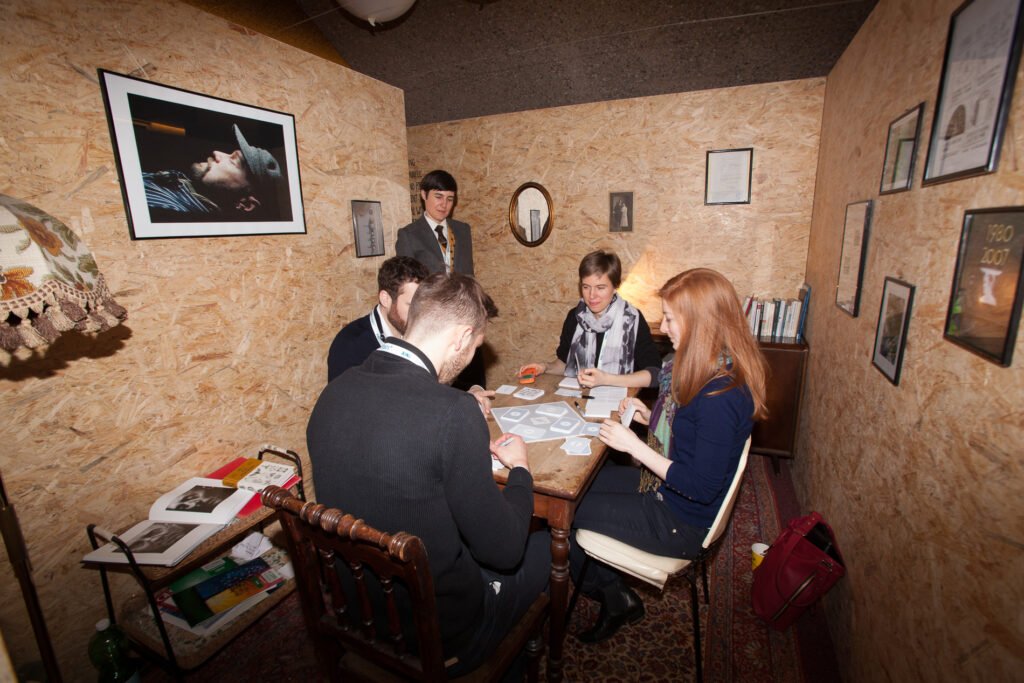
In spring 2015 we ran a pop-up Death Salon at the Lift innovation conference in Geneva. Over 150 people came through over the two days, and it felt like the topic firmly belonged in that space. Virginie and Lea developed a card game, Last Wills, to get people talking about what they actually want when they die, and a set of comics called Learnings from Death that turned our research into something people would actually want to read. We were featured in Business Punk, and kept running workshops whenever we found the time.
And yet, Redesigning Death itself eventually died, the way projects do, though my fascination with the subject never did. From there things kept branching. I taught a course called How to Face Death at the School of Life. I ran a DIY funeral workshop with a room full of pensioners in Leeds, who were, rather brilliantly, on a mission to make their city an age-friendly smart city. (More on that particular afternoon in the next post) I collaborated briefly with Mymoria, a modern online undertaker service. I helped design a digital learning room for the charity Malteser, Via Trauerbegleitung, and I continued to have countless conversations with strangers who were surprisingly delighted to broach the topic.
Then in 2020, one such stranger called me out of the blue, Patrick. He'd been circling this space too, and wanted to do something in it together. It was clear from the first conversation that we shared the same passion for opening space for death and loss, and I knew instantly that I wanted to work with him. A few weeks later, we launched OverMyDeadBody. We started meeting monthly with a small community, and the same people kept coming back, month after month. That's when we knew we were onto something.
So, what got me into all this death stuff? Apparently I've been getting into it for over a decade now, one strange and not remotely morbid detour at a time.