

Becoming an End-of-Life Companion, Part 8: Emotions and the Family System
We recently had another full day of training at the hospice, focused on two topics: emotions, and the family system around a dying person.
For the first time since starting the program, there was some tension in the room. At least for me, and a few others, the morning session on emotions didn't quite feel like a safe space to actually open up and talk about what we were feeling. It ended up being a good demonstration of something important: what kind of energy you bring into a room shapes whether others feel safe enough to open up. The more training I go through, the clearer it becomes that this work is really more about you than about the dying person. It takes real effort to stay in your own inner balance, so that you're actually able to be of service to someone else.
Some of what I took away from this session:
❧ There are many emotions
Different frameworks exist, but most distinguish between primary and secondary emotions. It helps to become familiar with the wide range of possible emotions, so it's easier to recognize and name them when we feel them ourselves, or notice them in someone else.
❧ Putting emotions into words helps
It can help to name the emotions you sense in a dying person, especially with older people who aren't used to naming, or even talking about, what they feel. Done the right way, it shows them it's completely okay to feel whatever they're feeling, and to talk about it openly.
❧ Reading non-verbal cues is tricky
If a dying person pushes your hand away, that doesn't necessarily mean they're rejecting you. More often, it has to do with their own process of letting go, something they need to do in order to be able to leave. This happens fairly often, but can feel hurtful to relatives who don't understand what's going on.
❧ Don't ask "why"
When talking to people with dementia, it's best to avoid questions that start with "why." They tend to cause confusion rather than clarity.
❧ Don't try to fix the family system
Every family around a dying person has its own logic and, in some way, its own way of functioning. When you step into that system, be careful with quick judgments about certain family members. It's not your job to mediate, or to fix a system just because it looks broken to you.
❧ Don't fill the gap
At the same time, be careful that the family doesn't push you into the role of the dying person. As that person becomes less and less able to function, a gap opens up in the family system, one that needs filling, but not by you.
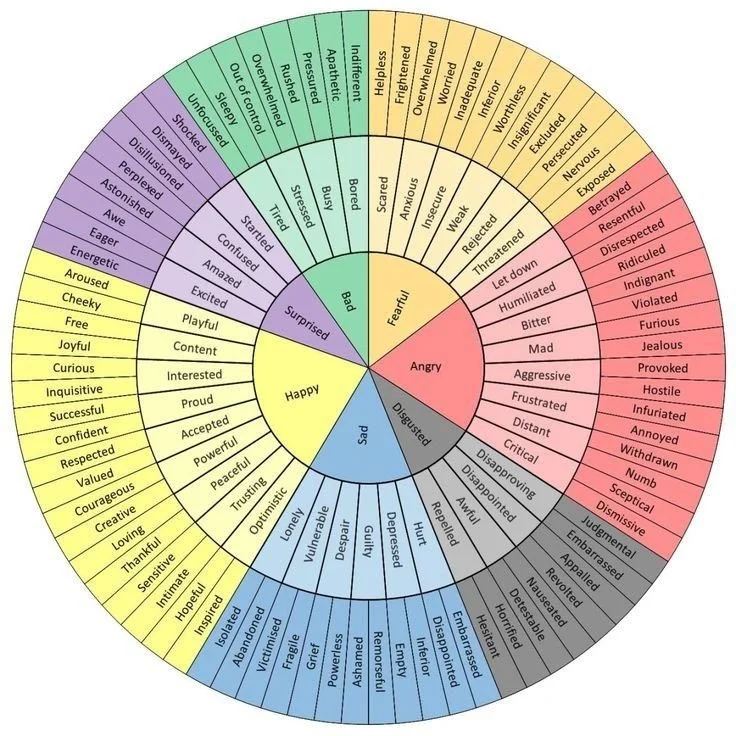
Wheel of Emotions by Robert Plutchik