

Becoming an End-of-Life Companion, Part 13: Mr. K
This is part 13 of my journey through an 8-month certification program to become an end-of-life companion at a hospice in Berlin.
A couple of weeks ago, a hospice coordinator asked me if I felt ready to start volunteering. I said yes.
So that same day, we drove to my first "client," Mr. K, so the coordinator, who had already visited him once, could introduce us. Mr. K was approaching the end of his life but was still living at home. I was excited and nervous, hoping he'd like me and not turn me away as a volunteer, which does happen. When we arrived at his apartment, we got off to a pretty rough start. He'd forgotten about the appointment entirely, so he wasn't ready and didn't feel comfortable receiving visitors. I felt uncomfortable too. Mr. K wasn't in good shape, and his living conditions, he lived alone, came as a real shock to me. I felt tremendous sympathy for him, and, at the same time, for myself, because just being in that apartment was already a huge challenge for me. Why hadn't I been assigned to someone living in a nice apartment, with family, or at least a partner, taking care of both the person and the household? I'm fully aware of how naive, selfish, and honestly unkind these thoughts were, but they're what I was thinking and feeling in that moment, and I want to be honest about that.
After a brief introduction, the coordinator left so Mr. K and I could get to know each other and spend some time together. I have to admit, in "normal life," I would never have met someone like Mr. K. It was obvious to both of us that we came from very different backgrounds, with little, if any, common ground. I did my best to keep the conversation going and connect on different levels, but I don't think I really managed to create a connection. We spent most of the time fixing things together, like a video recorder that wasn't working properly, which felt good, at least I had the sense I was doing something useful. At one point, he put in a VHS tape to check if the player worked, and it turned out to be an episode of Alf. My face lit up immediately, and I told him excitedly how I used to watch every episode as a kid. I thought this would finally be our moment of connection. Mr. K thought otherwise. Again, I felt disappointed. Even though I knew this wasn't about me, wasn't about what I wanted or needed, I still felt defeated that I hadn't managed to connect with him. It was only in that moment that I truly understood how absurd, and how selfish, it is to expect anything from someone who is dying. After two hours, I left, and we agreed to meet again the following week.
I came back a week later, motivated to take our relationship a step further, to finally connect. But Mr. K's condition had worsened considerably since the week before. He made it clear he didn't have the strength, or the interest, for small talk. What he needed was help with practical things that mattered to him, like paperwork. He told me he hadn't eaten in two days, because his fingers hurt too much from chemotherapy to prepare anything for himself. So I went shopping for him, made him a light dinner, and something for breakfast the next day. We didn't talk much during that visit. Mr. K was exhausted, and starting a conversation didn't feel right when he needed all his energy just to get through the tasks at hand. After I left, I called the hospice to push for support, it was clear he couldn't keep living like this. They assured me someone would soon visit him daily to help with shopping and cooking.
The following week, when I called to confirm our appointment, he told me he was at the hospital, he'd felt worse the night before. He sounded worried. I think it was the first time I sensed he truly understood what was happening to him. We had a longer conversation, and I asked whether he could imagine moving to a hospice, where he'd have more comfort than at the hospital. He agreed, so I called the hospice again to let them know about his condition and his wish to be admitted. The next day, I left for a holiday, and in agreement with the hospice, I "handed over" Mr. K to one of the coordinators. There was nothing I could do for him from abroad, and I needed a break. In total, I'd only visited him twice, though I'd spent a lot of time in training and at the hospice around that period. Death had become a constant presence in my life, and I needed some distance from it. I felt exhausted, and honestly, a bit useless.
Two weeks later, I got word that Mr. K had died at a hospice in Berlin. My feelings were mixed. I was deeply relieved he'd died somewhere he was cared for, rather than alone in his apartment or at the hospital. At the same time, I felt profoundly sad, and guilty. Mr. K had no family, no friends. I'm almost certain no one visited him at the hospice. That should have been my job. It felt like my two visits hadn't made any real difference, and that when I actually had a chance to make one, I wasn't there. I know accepting these feelings is part of my own process, and that, again, this isn't supposed to be about me. But I also owe myself the honesty that I'm still learning.
Thank you, Mr. K, for the gift of remembering how much joy Alf gave me as a kid. I'll think of you every time I watch an episode.
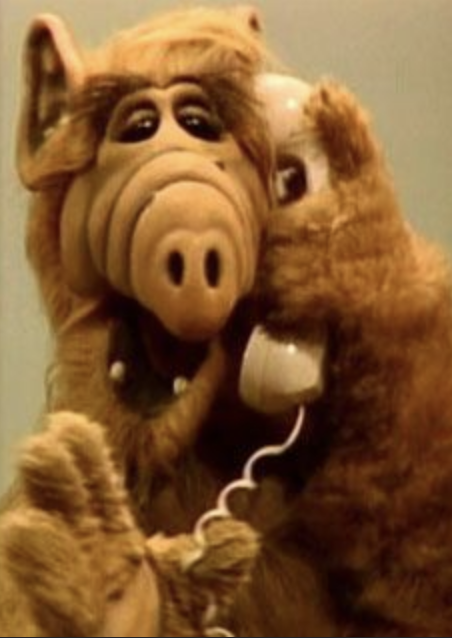
The 1980s sitcom character ALF. Image used under fair use for commentary on the author's narrative experience. (Copyright © Alien Productions).